「ロキソニンSが、薬剤師のいない時間でも買えるようになる」。7月末、そんなニュースが出ました。店舗では、もう売り方を変える話なのか。そこが最初の分かれ目です。
“Loxonin S will become available even when no pharmacist is present.” News like this appeared in late July. Does that mean stores should already change how they sell it? That is the first distinction to make.
結論から言うと、2026年8月16日時点では変わっていません。今回の見直し対象である内服のロキソプロフェン(ロキソニンSなど)は、現在も第1類医薬品です。7月29日に厚生労働省の調査会で審議されましたが、正式な区分変更の告示と施行は確認できていません。
The answer is that nothing had changed as of August 16, 2026. Oral loxoprofen products, including Loxonin S, which are under review, remain Class 1 OTC medicines. An MHLW committee discussed them on July 29, but an official notice changing the classification and its implementation have not been confirmed.
この話で大事なのは、「検討が進んだ」と「今日から売り方が変わった」を分けることです。
The important distinction here is between “the review has advanced” and “sales practices changed today.”
7月29日は審議まで。告示と施行はまだ
July 29 was a deliberation. Official notification and implementation are still pending
まず、現在地を一枚にまとめました。
First, I have summarized the current position in a single figure.
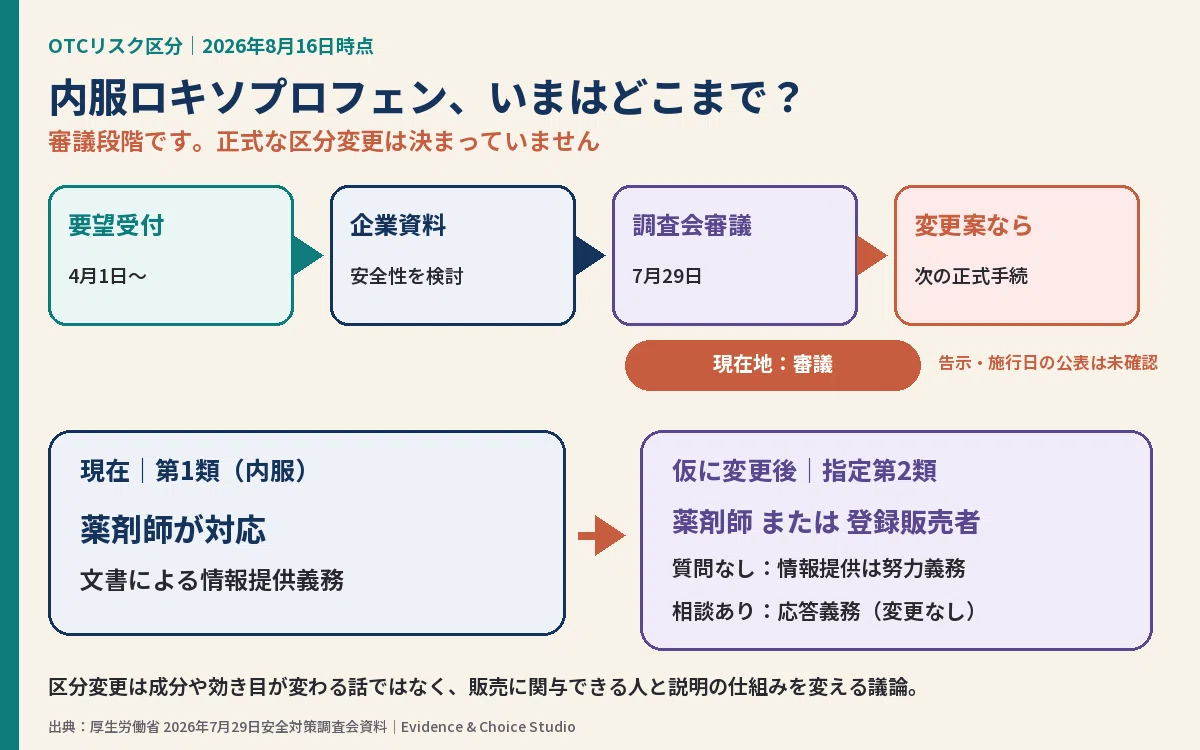
厚生労働省は2026年4月1日から、一般用医薬品のリスク区分を見直す要望を随時受け付ける仕組みを始めました。長く同じ区分に置かれてきた成分について、市販後の安全性や実際の使われ方を見直すためです。
On April 1, 2026, MHLW introduced a system accepting requests to review OTC medicine risk classifications on an ongoing basis. Its purpose is to reconsider post-marketing safety and actual usage for ingredients that have remained in the same category for a long time.
8月1日時点の要望申出状況には、3成分が載っています。
The list of submitted requests as of August 1 contains three ingredients.
ロキソプロフェン(外用剤を除く):第1類から指定第2類へ
ファモチジン:第1類から指定第2類へ
トラネキサム酸(しみ〈肝斑に限る〉改善薬):第1類から第2類へ
Loxoprofen, excluding topical preparations: from Class 1 to Designated Class 2
Famotidine: from Class 1 to Designated Class 2
Tranexamic acid for improving pigmentation limited to melasma: from Class 1 to Class 2
ここで見直すのは、原則として商品名ではなく成分単位です。「ロキソニンS」という身近な商品から話題になっていますが、手続そのものは外用剤を除くロキソプロフェンという成分について進みます。
In principle, the review concerns individual ingredients rather than brand names. The familiar product Loxonin S has attracted attention, but the procedure concerns loxoprofen, excluding topical preparations.
そして、要望が載っただけで区分は変わりません。企業の見解や安全性資料を集め、調査会で審議し、その後の正式な手続を経て、初めて販売方法が変わります。
A submitted request alone does not change the classification. Sales practices change only after company views and safety materials are collected, committee deliberations take place, and the subsequent formal procedures are completed.
指定第2類へ変わっても、薬が弱くなるわけではない
A change to Designated Class 2 would not make the medicine weaker
第1類から指定第2類へ「下がる」と聞くと、薬の効き目や注意点まで軽くなったように感じます。しかし、薬そのものの効き目が弱くなるわけではありません。
Hearing that a medicine is being “downgraded” from Class 1 to Designated Class 2 can make its effects and precautions sound less significant. However, the medicine itself does not become less potent.
変わるのは、誰が販売に関与できるか、どのように情報を伝えるかです。
What changes is who may participate in selling it and how information is provided.
現在の第1類では、薬剤師が対応し、購入者から質問がなくても原則として文書で情報提供を行う義務があります。仮に指定第2類へ変われば、薬剤師だけでなく、第2類・第3類医薬品を販売できる専門職である登録販売者も対応でき、質問がない場合の情報提供は努力義務になります。ただし、購入者から相談があったときに応じる義務は変わりません。
Under the current Class 1 rules, a pharmacist must handle the sale and, in principle, provide written information even if the purchaser asks no questions. If the product were changed to Designated Class 2, registered OTC medicine sellers, professionals authorized to sell Class 2 and Class 3 medicines, could handle sales alongside pharmacists. Providing information when no question is asked would become an obligation to make an effort. The duty to respond when a purchaser seeks advice would remain unchanged.
この差は小さくありません。薬剤師がいない時間帯にも販売できる可能性が広がり、店舗の人員配置や売場の作り方が変わり得るからです。
This is a substantial difference. It could broaden the hours when sales are possible without a pharmacist present and change store staffing and sales-area layouts.
ただし、「指定第2類になれば、どこでも簡単に買える」とまでは言えません。医薬品を販売できる店舗であること、専門家が対応できること、指定第2類に必要な陳列や注意喚起を行うことは別に必要です。
However, it would be premature to say that Designated Class 2 status means easy availability everywhere. Stores would still need authorization to sell medicines, access to an appropriate professional, and the displays and cautions required for Designated Class 2 products.
調査会は、登録販売者でも安全確認を保てるかを見ている
The committee is examining whether safety checks can be maintained with registered sellers
7月29日の安全対策調査会資料は、ロキソプロフェンの副作用だけを見ているわけではありません。
The July 29 Safety Measures Committee materials do not examine only loxoprofen's adverse effects.
妊娠後期の使用、併用薬、長く使い続けること、受診した方がよい症状を見逃さないこと。こうした注意点を、薬剤師だけでなく登録販売者が関与する販売でも守れるかが論点です。
Use in late pregnancy, concomitant medicines, prolonged use, and recognizing symptoms that require medical attention are among the concerns. The question is whether these precautions can be maintained when registered sellers, rather than only pharmacists, participate in sales.
資料には、仮に区分を変える場合に考えられる対応として、次のような項目が示されています。これらは企業案や一般的な検討論点であり、ロキソプロフェンについて確定した販売条件ではありません。
The materials list measures that could be considered if the classification changes. These are company proposals or general discussion points, not finalized sales conditions for loxoprofen.
登録販売者への研修
販売時の確認と説明、必要時の薬剤師との連携
店舗での陳列・掲示、相談につなぐ流れ
製造販売業者によるチェックリストなどの資材提供
変更後の販売実態と適正使用の把握
Training for registered OTC medicine sellers
Checks and explanations at sale, with pharmacist coordination when necessary
In-store displays and notices, and a process for directing people to advice
Checklists and other materials supplied by marketing authorization holders
Monitoring actual sales practices and appropriate use after the change
つまり、区分変更は単なる「規制緩和」ではありません。薬剤師に限られていた関与を広げる代わりに、どの安全策を販売現場へ残すかを組み直す議論です。
In other words, reclassification is not simply deregulation. It is a discussion about redesigning the safeguards retained at the point of sale while widening participation beyond pharmacists.
正式施行までは、第1類の売り方を続ける
Continue Class 1 sales practices until formal implementation
現時点で、店舗の販売方法を変える必要はありません。内服のロキソプロフェン(ロキソニンSなど)は第1類として扱い、薬剤師による対応と情報提供を続けます。
At present, stores do not need to change their sales practices. Oral loxoprofen products, including Loxonin S, should continue to be treated as Class 1, with pharmacists handling sales and providing information.
先にできるのは、最終条件が出たときに慌てないための棚卸しです。
What can be done in advance is to review readiness so that the final conditions do not prompt a last-minute scramble.
登録販売者に必要な研修を、誰がどのように行うか
確認項目や受診勧奨を、どの資材で揃えるか
薬剤師へつなぐ条件を、店舗内でどう共有するか
陳列・掲示、オンライン画面をどこまで直す必要があるか
Who will provide the necessary training for registered sellers, and how?
Which materials will standardize checks and recommendations to seek medical care?
How will staff share the criteria for referring a customer to a pharmacist?
How much will displays, notices, and online screens need to change?
ただし、これらは準備の論点です。研修内容やチェックリストが確定したという意味ではありません。
These are preparation topics. They do not mean that training content or checklists have been finalized.
次に確認したいのは、厚生労働省の議事録、意見募集、正式告示、施行日、最終的な販売条件です。そこが出るまでは、「変更が決まった」ではなく「変更条件を詰めている」と読むのが安全です。
The next things to check are MHLW minutes, public consultations, the formal notice, the effective date, and final sales conditions. Until those appear, it is safer to read the situation as “conditions for a change are being worked out” rather than “the change is settled.”
第1類から指定第2類へ。これは薬の強さの順位を付け替える話ではなく、誰がどこまで確認し、どう説明するかを組み替える話です。
From Class 1 to Designated Class 2: this is a change in who checks what and how they explain it, rather than a new ranking of medicine strength.
※この記事は2026年8月16日時点の公表資料にもとづく一般的な制度解説です。正式な区分変更、施行日、最終的な販売条件は今後の公式情報をご確認ください。個別の購入・使用判断は製品の表示を確認し、薬剤師または登録販売者へご相談ください。
Note: This article provides a general explanation of the system based on materials published as of August 16, 2026. Check future official information for formal reclassification, the effective date, and final sales conditions. For individual purchase or use decisions, check the product labeling and consult a pharmacist or registered OTC medicine seller.
More from the author
Read on note, or subscribe to the Japanese and English publications on Substack.
Sharing uses the publicly accessible original article URL.