夕方、ドラッグストアで市販薬の箱を持ってレジへ行くと、「この薬は、いま薬剤師がいないので販売できません」と言われることがあります。隣の棚には同じ症状に使う薬が並んでいるのに、なぜこの箱だけ買えないのでしょうか。
In the evening, you take a box of OTC medicine to a drugstore checkout and are told, “We cannot sell this medicine because there is no pharmacist here right now.” Medicines for the same symptoms sit on the next shelf, so why is this particular box unavailable?
まず見たいのは、箱に枠で囲んで表示された「要指導医薬品」「第1類医薬品」「第2類医薬品」「第3類医薬品」の文字です。この表示は、単に薬の強さを並べた順位ではありません。安全に買って使うために、誰から、どのような確認や説明を受けるかを示す目印です。
The first thing to check is the boxed classification on the packaging: “guidance-required medicine,” “Class 1 OTC medicine,” “Class 2 OTC medicine,” or “Class 3 OTC medicine.” These labels are not simply a ranking of medicine strength. They indicate who should check your situation and what explanations you should receive to buy and use the medicine safely.
市販薬は「要指導医薬品」と「一般用医薬品」に分かれます
Nonprescription medicines are divided into guidance-required medicines and general OTC medicines
処方箋なしで購入できる医薬品は、まず「要指導医薬品」と「一般用医薬品」に分かれます。さらに、一般用医薬品が、副作用などのリスクに応じて第1類・第2類・第3類に分かれます。
Medicines available without a prescription are first divided into guidance-required medicines and general OTC medicines. General OTC medicines are further divided into Classes 1, 2, and 3 according to risks such as adverse effects.
要指導医薬品には、医療用から市販へ切り替わって間もないなど、一般の人が使用した実績がまだ限られ、薬剤師による個別の確認と指導が必要な薬が含まれます。そのため、要指導医薬品を第1類より危険な「第0類」のように扱うのは正確ではありません。
Guidance-required medicines include products that have only recently switched from medical use to OTC availability, with limited experience of use by the general public, and therefore require individual checks and guidance from a pharmacist. It is inaccurate to treat this category as a “Class 0” that is more dangerous than Class 1.
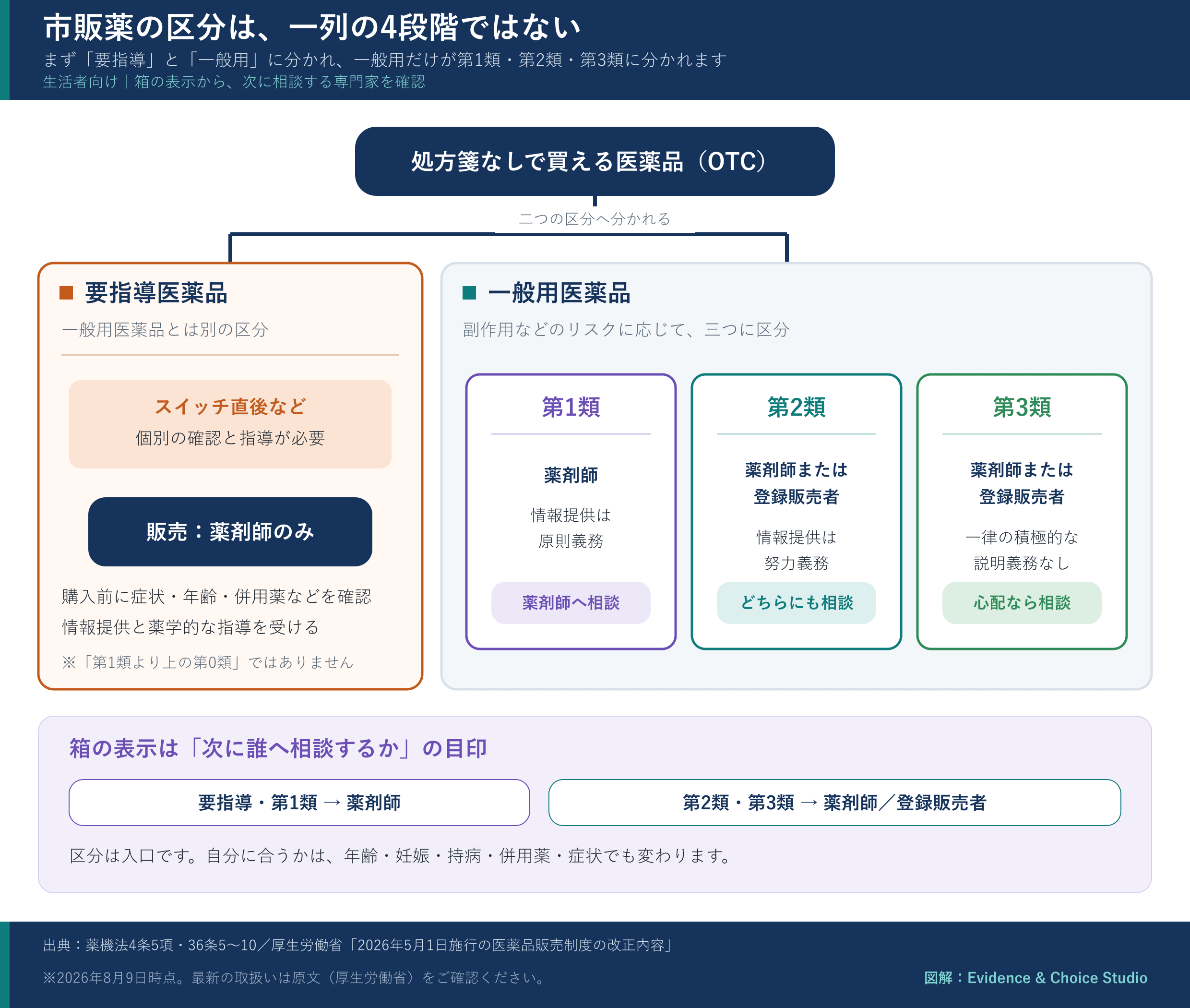
一方、第1類・第2類・第3類は、一般用医薬品の中を副作用などのリスクに応じて分けた区分です。ただし、「第3類なら誰にでも安全」「第1類なら危険だから避ける」と数字だけで判断するものではありません。
Classes 1, 2, and 3, by contrast, are subdivisions of general OTC medicines based on risks such as adverse effects. However, the numbers alone do not mean “Class 3 is safe for everyone” or “Class 1 is dangerous and should be avoided.”
要指導医薬品と第1類は、薬剤師へ
For guidance-required and Class 1 medicines, speak to a pharmacist
要指導医薬品を販売できるのは薬剤師です。購入前に、症状、年齢、使用中の薬などを確認し、説明と薬学的な指導を受けます。確認の結果、その人が適切に使えると判断できなければ販売されません。
Only pharmacists may sell guidance-required medicines. Before purchase, they check symptoms, age, medicines currently being used, and other details, and provide explanations and pharmaceutical guidance. If these checks do not establish that the person can use the medicine appropriately, it will not be sold.
第1類医薬品を販売できるのも薬剤師です。購入時には、書面や画面を使った情報提供を受けるのが原則です。
Only pharmacists may sell Class 1 OTC medicines as well. In principle, purchasers receive information in writing or on a screen.
そのため、要指導医薬品か第1類医薬品を買おうとした時間に薬剤師がいなければ、その場では購入できません。レジの担当者が不親切なのではなく、その人の判断だけでは販売できない区分なのです。
Therefore, if no pharmacist is present when you try to buy a guidance-required or Class 1 medicine, you cannot purchase it there at that time. The cashier is not being unhelpful; this classification does not allow them to authorize the sale on their own.
第2類と第3類は、登録販売者にも相談できる
For Class 2 and Class 3 medicines, registered sellers can also advise
第2類医薬品と第3類医薬品は、薬剤師のほか、登録販売者も販売できます。登録販売者は、市販薬のうち第2類と第3類を扱える専門資格です。
Class 2 and Class 3 OTC medicines may be sold by registered OTC medicine sellers as well as pharmacists. Registered sellers hold a professional qualification authorizing them to handle these two classes of OTC medicines.
第2類では、販売する側が積極的に情報を伝えることは努力義務です。第3類には区分固有の積極的な説明義務はありません。ただし、これは「説明を求めてはいけない」「自分だけで選ぶ薬」という意味ではありません。心配なことがあれば、第2類でも第3類でも薬剤師や登録販売者へ相談できます。
For Class 2 products, sellers have an obligation to make an effort to provide information proactively. Class 3 has no classification-specific duty to offer proactive explanations. However, this does not mean you must not ask for an explanation or must choose entirely on your own. If you have concerns, you can consult a pharmacist or registered seller about either class.
なお、箱に丸や枠で強調された「2」がある指定第2類医薬品は、第2類の中でも特に注意が必要な薬です。独立した5番目の区分ではありません。また、2026年5月に始まった指定濫用防止医薬品も、購入量などの確認が加わる別軸のルールで、第1〜3類に代わる分類ではありません。
Designated Class 2 medicines, marked with an emphasized “2” in a circle or box, require particular caution within Class 2. They are not a separate fifth category. Likewise, the designated misuse-prevention medicine rules introduced in May 2026 add purchase-quantity and other checks on a separate basis; they do not replace Classes 1–3.
箱のどこを見ればよいか
Where to look on the box
区分名は、箱の表面や側面に枠で囲んで表示されています。商品名のすぐ近くにあるとは限らないので、箱を少し回して側面も見てください。
The classification appears inside a border on the front or side of the box. It is not always immediately next to the product name, so turn the box to check the sides as well.
同じ「胃薬」「鼻炎薬」「痛み止め」の棚に並んでいても、区分が違うことがあります。症状の名前や棚の位置だけでは、誰が販売する薬かまでは分かりません。
Products on the same “stomach medicine,” “rhinitis medicine,” or “pain relief” shelf may have different classifications. The symptom name or shelf position alone does not tell you which professional may sell the medicine.
空箱だけが棚に置かれ、薬剤師のいるカウンターで中身を受け取る商品もあります。その場合も、箱の表示を見れば、なぜ会計の前に専門家の確認が入るのかを理解しやすくなります。
For some products, only empty boxes are displayed, and the medicine is supplied at a counter staffed by a pharmacist. Here too, checking the classification helps explain why a professional must check your situation before checkout.
「いま買えません」と言われたときの3つの確認
Three things to check when told, “You cannot buy it right now”
薬剤師がいないために要指導医薬品や第1類医薬品を買えなかったら、次の三つを確認します。
If you cannot buy a guidance-required or Class 1 medicine because no pharmacist is present, check these three things.
薬剤師が戻る時間、または薬剤師がいる別の店舗
その商品で利用できるオンライン相談やオンライン販売があるか
同じ症状について、いま相談できる薬剤師や登録販売者がいるか
When the pharmacist will return, or whether another store has a pharmacist present
Whether online consultation or online sales are available for that product
Whether a pharmacist or registered seller is available now to discuss the same symptoms
2026年5月1日からは、要指導医薬品でも、一部を除いて薬剤師のビデオ通話による確認と指導を受けたうえでオンライン購入できる仕組みが始まりました。ただし、すべての要指導医薬品や店舗が対応するわけではなく、薬剤師が対面での確認が必要と判断する場合もあります。
From May 1, 2026, a system began allowing online purchase of guidance-required medicines, with some exceptions, after a pharmacist conducts checks and provides guidance by video call. However, not all such medicines or stores support this, and a pharmacist may decide that in-person checks are necessary.
ここで避けたいのは、「薬剤師がいらない区分なら同じだろう」と、自己判断で別の商品へ置き換えることです。似た箱でも、成分、使える症状、使えない人が違います。買おうとしていた商品名を示し、「いま使える別の薬はありますか」と相談してください。すでに使っている薬がある場合は、お薬手帳や薬の名前が分かるものも一緒に見せます。
Avoid substituting another product on your own on the assumption that a category not requiring a pharmacist must be equivalent. Similar-looking boxes may contain different ingredients, cover different symptoms, or be unsuitable for different people. Show the product name you intended to buy and ask, “Is there another medicine I can use now?” If you are already using medicines, also show your medication record or something identifying their names.
同じ区分でも、使えるかどうかは年齢・持病・併用薬で変わります
Even within one class, suitability depends on age, health conditions, and other medicines
箱の区分から分かるのは、その薬を販売できる専門家と、購入時に必要な確認や説明です。実際に自分が使えるかどうかは、区分だけでは決まりません。
The classification tells you which professional may sell a medicine and what checks or explanations are needed at purchase. It does not by itself determine whether you can use it.
年齢、妊娠、持病、使用中の薬、症状が続いている期間によって、使えない場合や、購入前に相談が必要な場合があります。第3類でも確認が必要な人はいます。第1類でも、薬剤師が年齢や使用中の薬などを確認し、適切に使えると判断すれば購入できます。
Age, pregnancy, existing conditions, current medicines, and how long symptoms have lasted may mean that you cannot use a product or need advice before purchase. Some people need checks even for Class 3 products. A Class 1 product can be purchased if a pharmacist checks age, current medicines, and other relevant factors and determines that appropriate use is possible.
箱の区分を確認したら、説明書の「してはいけないこと」と「相談すること」も読んでください。自分が条件に当てはまるか分からない場合は、商品名を示して薬剤師または登録販売者へ相談します。使用中の薬がある場合は、お薬手帳や薬の名前が分かるものも一緒に見せてください。
After checking the classification, also read the leaflet sections headed “Do not” and “Consultation.” If you are unsure whether a condition applies to you, show the product name to a pharmacist or registered seller and ask. If you are taking other medicines, show your medication record or something identifying their names as well.
※本記事は、2026年8月9日までに確認できた公開情報にもとづく一般的な情報提供です。実際に購入できるか、どの薬が症状に合うかは、製品、体調、年齢、妊娠、持病、使用中の薬などによって異なります。最新の箱の表示と説明書を確認し、迷う場合は薬剤師または登録販売者へご相談ください。症状が強い、長く続く、または急に悪化した場合は、医療機関への相談もご検討ください。
Note: This article provides general information based on public sources checked through August 9, 2026. Whether you can purchase a product and which medicine suits your symptoms depend on the product, your condition, age, pregnancy, existing illnesses, current medicines, and other factors. Check the latest packaging and leaflet, and consult a pharmacist or registered OTC medicine seller if uncertain. If symptoms are severe, persistent, or suddenly worsen, consider consulting a medical facility as well.
More from the author
Read on note, or subscribe to the Japanese and English publications on Substack.
Sharing uses the publicly accessible original article URL.