市販薬のオーバードーズを防ぐため、店頭では年齢や購入数を確認します。では、確認を厳しくすれば、困っている人は相談につながるのでしょうか。
Stores check customers' ages and purchase quantities to help prevent overdoses of OTC medicines. But do stricter checks help people who are struggling find someone to talk to?
2026年6月に公表された国内のオンライン調査では、市販薬を本来の治療とは別の目的で使ったと回答した人の割合は6.8%でした。そして、該当した人のうち、誰かに助けを求めた人は46.9%。半数以上は相談していませんでした。
A Japanese online survey published in June 2026 found that 6.8% of respondents reported using OTC medicines for purposes other than their intended treatment. Among those respondents, 46.9% had sought help from someone. More than half had not sought help.
この二つを一緒に見ると、問題は「何箱買えるか」だけではないと分かります。買う場面で止めることと、相談できる入口を作ることは、別の仕事です。
Taken together, these findings show that the issue extends beyond how many boxes someone can buy. Preventing a purchase and creating a route to support are different tasks.
6.8%は、日本人全体の確定値ではない
6.8% is not a definitive figure for Japan's entire population
調査は2025年2月23日から3月31日に行われ、15〜84歳の25,424人を解析しました。インターネット調査への参加者を募る非確率抽出で、選ばれ方の偏りを小さくするために重み付けをしています。
The survey took place from February 23 to March 31, 2025, and analyzed responses from 25,424 people aged 15–84. It used nonprobability sampling to recruit online participants, with weighting to reduce selection bias.
研究では、7つの市販薬カテゴリーについて、推奨量を超えて使った人の中から、研究上の定義に当てはまる非医療目的使用を数えました。
Across seven OTC medicine categories, the study counted use meeting its definition of nonmedical use among people who had exceeded recommended doses.
したがって6.8%は、研究で決めた条件と重み付けにもとづく推定です。「日本人の6.8%が市販薬を乱用している」と言い切れる数字ではありません。
The 6.8% figure is therefore an estimate based on the study's criteria and weighting. It does not justify a definitive statement that “6.8% of Japanese people misuse OTC medicines.”
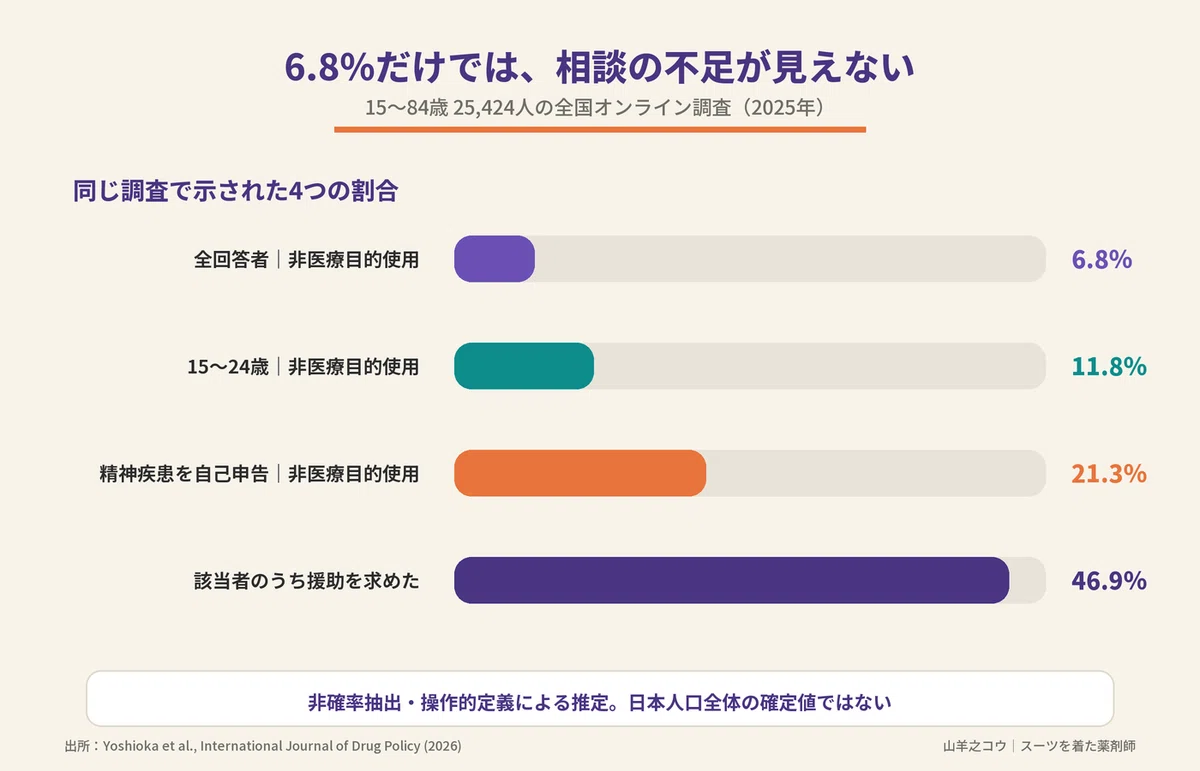
6.8%だけを見ると、見落とす三つのこと
Three things you miss by looking only at 6.8%
一つ目は年齢です。15〜24歳では11.8%でした。全年齢の6.8%より高く、若い人に届く入口が必要だと分かります。
The first is age. The figure was 11.8% among people aged 15–24, higher than the overall 6.8%. This points to a need for routes to support that reach young people.
二つ目は、精神疾患を自己申告した回答者では21.3%だったことです。ただし、この調査は一時点の横断調査です。精神疾患が市販薬の非医療目的使用を引き起こした、あるいはその逆だと因果関係を示したものではありません。
The second is that the figure was 21.3% among respondents who self-reported a mental illness. However, this was a cross-sectional survey at one point in time. It does not establish that mental illness caused nonmedical OTC use, or the reverse.
三つ目は、該当した人のおよそ3分の2が複数の薬剤カテゴリーにまたがる使用を報告したことです。一つの商品、一つの成分、ひとつの店だけを見ても、全体が見えない場合があります。
The third is that roughly two-thirds of those meeting the criteria reported use across multiple medicine categories. Looking at just one product, ingredient, or store may miss the wider picture.
「売らない」で終わると、相談の入口を失う
Ending the conversation at “we cannot sell it” can close a route to support
薬局・ドラッグストアは、すべての薬剤カテゴリーで最も多い入手先でした。割合は38.3〜45.9%です。だから、販売時の確認は重要です。
Pharmacies and drugstores were the most common sources across all medicine categories, accounting for 38.3–45.9%. That makes checks at the point of sale important.
一方で、購入を断ることだけが目的になると、困っている人は別の店へ行くか、話すことをやめるかもしれません。今回の調査で援助を求めた人が46.9%だったことを考えると、販売の場は「止める場所」であると同時に「話せる場所」である必要があります。
However, if refusing a sale becomes the sole objective, a person who is struggling may go to another store or stop talking. Given that only 46.9% in this survey sought help, the point of sale needs to be both a place that intervenes and a place where people can talk.
厚生労働省も、薬剤師・登録販売者にゲートキーパーとしての役割を求めています。相談窓口の一覧を渡すだけの機械的な対応ではなく、状況に応じて窓口の担当者につなぐところまで丁寧に対応するよう示しています。
The Ministry of Health, Labour and Welfare also asks pharmacists and registered OTC medicine sellers to act as gatekeepers. Its guidance calls for a considerate response tailored to the situation, including connecting people with staff at support services, rather than mechanically handing over a list of contacts.
2026年5月の規制強化の効果は、この調査では分からない
This survey cannot show the effects of tighter rules introduced in May 2026
指定された8成分を含む市販薬は、2026年5月から販売時の確認が強化されました。若年者への販売量、年齢、ほかの店での購入状況などを確認します。
From May 2026, stronger checks were introduced for sales of OTC medicines containing eight designated ingredients. These cover matters such as quantities sold to younger people, age, and purchases at other stores.
ただし、今回の調査が行われたのは2025年2〜3月です。新しい制度が始まる前なので、規制強化によって非医療目的使用が増えた、減った、相談が増えたということは、この研究からは判断できません。
However, this survey was conducted in February and March 2025, before the new system began. It cannot tell us whether the stricter rules increased or reduced nonmedical use or led to more people seeking help.
いま必要なのは、規制後の販売件数だけでなく、声をかけた後にどれだけ相談へつながったかを見ることです。
What we need to examine now is not just sales after the rules changed, but how often an initial conversation leads to support.
責めずに、次の一歩を一緒に決める
Decide on the next step together, without blame
本人へ声をかけるときは、「どうしてそんなことをしたのか」と責めるより、「最近、薬を多く使うことが続いていますか」「いま困っていることはありますか」と、答えを決めつけずに聞くほうが話しやすくなります。
When approaching someone, open questions such as “Have you been using a lot of medicine lately?” or “Is anything troubling you right now?” can make it easier to talk than blaming them by asking, “Why did you do that?”
薬の使い方なら薬剤師。つらい気持ちや、やめたくてもやめられない状態なら精神保健福祉センターなど、相談内容によって入口は変わります。厚生労働省のページには、地域の窓口やSNSを含む相談先がまとめられています。
The appropriate starting point depends on the concern: a pharmacist for medicine use, or a mental health and welfare center, for example, for emotional distress or being unable to stop despite wanting to. The ministry's website lists local services and other support options, including social media.
もし、すでに大量に服用して意識がもうろうとしている、呼吸がおかしい、けいれんしているなど、命に関わる状態なら、相談窓口を探す前に119番です。
If someone has already taken a large amount and is in a life-threatening condition, such as reduced consciousness, abnormal breathing, or convulsions, call 119 before looking for a consultation service.
販売時の確認は必要です。しかし、そこで会話が切れたら、半数以上が相談していなかったという問題は残ります。箱数を数えるだけでなく、次に話せる人へつなぐ。市販薬の販売現場に必要なのは、その二つを離さないことです。
Checks at the point of sale are necessary. But if the conversation ends there, the problem that more than half had not sought help remains. Count the boxes, and connect the person with someone they can talk to next. Medicine retailers need to keep both responsibilities together.
※本記事は2026年8月17日時点の一般情報です。研究は非確率抽出のオンライン横断調査であり、日本人口全体の確定的な有病率や因果関係を示すものではありません。
Note: This article provides general information as of August 17, 2026. The study was a nonprobability online cross-sectional survey and does not establish definitive prevalence for Japan's entire population or causal relationships.
More from the author
Read on note, or subscribe to the Japanese and English publications on Substack.
Sharing uses the publicly accessible original article URL.