英国の薬局では、片頭痛のトリプタン製剤、勃起不全の治療薬、プロゲストゲン単剤の経口避妊薬を、医師の診察を受けずに購入できます。同じリストを日本の薬局に持っていくと、3つとも医療機関を受診するよう案内されます。
In a UK pharmacy, you can buy a migraine triptan, an erectile-dysfunction tablet, and a progestogen-only contraceptive pill without seeing a doctor. Bring the same list to a Japanese pharmacy and you'll be sent to a clinic for all three.
これは、世界のセルフメディケーションをめぐる、あまり注目されていない謎の一つです。有効成分は同じです。臨床的なエビデンスも国境を越えて共有されています。それなのに、「自分で購入できるか」という問いへの答えは、どの国にいるかによって反転します。OTC戦略、市場アクセス、薬事に携わる人にとって、興味深い問いは、どの薬で扱いが異なるのかではありません。同じエビデンスから、なぜ異なる判断が生まれるのかということです。
This is one of the quieter puzzles in global self-medication. The molecule is identical. The clinical evidence crosses borders. Yet the answer to "can I buy this myself?" flips depending on which country you're standing in. For anyone in OTC strategy, market access, or regulatory affairs, the interesting question isn't which drugs differ. It's why the same evidence produces different verdicts.
今回は、海外の非処方箋販売例と、日本の承認・販売の違いを代表例で考えます。日本で処方薬のみの4例に加え、承認と店頭での入手を分けて読むため、国内OTC承認済みのナプロキセンも例外として残します。差を考えるには、審査の速度とリスク管理を見る必要があります。日本には必要な規制区分があり、その運用と個別製品の条件を一緒に確かめることが本記事の主題です。
This issue compares representative non-prescription examples abroad with approval and availability in Japan. Alongside four prescription-only examples, it retains naproxen as a Japanese OTC-approved exception to distinguish approval from access on the shelf. Understanding the differences means looking at review pace and risk management. Japan has a switch category; how it is used, alongside the conditions for individual products, is this article’s focus.
始める前に、一つ注意があります。規制上の位置づけは変わります。そして今、日本のこの政策分野では、その変化が速いのです。2年前なら「日本ではまだ処方箋が必要」というリストに当然入っていた薬のいくつかが、その後スイッチOTC化されています。こうした例をあえて取り上げるのは、原則よりも例外のほうが多くを物語るからです。
One caveat before we start. Regulatory status changes, and right now in this corner of Japanese policy it changes fast. Several drugs that would have sat comfortably on a "still prescription-only in Japan" list two years ago have since switched. I've flagged those on purpose, because the exceptions tell you more than the rule.
代表例:同じ成分でも、並ぶ棚は違う
The shortlist: same molecule, different shelf
以下は網羅的な一覧ではなく、2026年7月4日の本文基準で読む比較例です。4例は日本で処方薬のみ、ナプロキセンは2021年に国内OTC承認済みの例外です。ナプロキセンの掲載時点の発売・流通状況は、この資料では確認していません。
These are illustrative comparisons at the article’s July 4, 2026 reference date, not an exhaustive list. Four are prescription-only examples in Japan; naproxen is an exception approved as an OTC product in 2021. Its launch and distribution status at the article reference date have not been established from these materials.
| 成分 | 治療領域 | 海外の非処方箋販売例 | 日本(2026年半ばの本文時点) |
|---|---|---|---|
| スマトリプタン | 片頭痛の急性期治療 | 英国(薬局販売、2006年から)、スウェーデン | 日本では処方箋が必要。スイッチOTC化は繰り返し見送られ、2024年10月に再検討 |
| シルデナフィル | 勃起不全 | 英国(Viagra Connect:2017年再分類、2018年発売)、ニュージーランド | 日本では処方箋が必要 |
| クロラムフェニコール点眼薬 | 急性細菌性結膜炎 | 英国(薬局販売、2005年)、オーストラリア(S3) | 日本では処方箋が必要 |
| エソメプラゾール | 胸やけ/逆流(PPI) | 米国(Nexium 24HR)、オーストラリア(S3) | 日本では処方箋が必要。後述の「取り残された成分」を参照(近縁の3PPIの正式承認は2025年。下記参照。) |
| ナプロキセン(経口) | 痛み/月経痛(NSAID) | 米国(1994年)、オーストラリア(S2) | 2021年8月31日にモートリンNXが要指導医薬品として承認済み。掲載時点の発売・流通状況は本資料では未確認。 承認一次資料 |
| Ingredient | Treats | Non-prescription examples abroad | Japan (mid-2026 article reference) |
|---|---|---|---|
| Sumatriptan | Acute migraine | UK (pharmacy, since 2006); Sweden | Prescription-only; switch repeatedly deferred, re-examined Oct 2024 |
| Sildenafil | Erectile dysfunction | UK (Viagra Connect: reclassified 2017, launched 2018); New Zealand | Prescription-only |
| Chloramphenicol eye drops | Acute bacterial conjunctivitis | UK (pharmacy, 2005); Australia (S3) | Prescription-only |
| Esomeprazole | Heartburn / reflux (PPI) | US (Nexium 24HR); Australia (S3) | Prescription-only — see "survivors" below (Three other PPIs received formal approval in 2025; see below.) |
| Naproxen (oral) | Pain / period pain (NSAID) | US (1994); Australia (S2) | Motrin NX approved as a guidance-required OTC product on August 31, 2021. Launch and distribution at the article reference date are not established from these materials. Approval record |
出典:厚生労働省のスイッチOTC資料、英国MHRA、米国FDA、オーストラリアTGA、スウェーデンMPA。上の例は用量、剤形、包装、薬剤師関与などの販売条件によって区分が異なるため、成分名だけで無条件に買えるという意味ではありません。制度比較であり、個別の製品推奨や医療上の助言ではありません。
Sources: MHLW switch-OTC materials, UK MHRA, US FDA, Australia TGA and Sweden MPA. Classification depends on dose, formulation, pack and supply conditions such as pharmacist involvement; these examples do not mean unrestricted access to every product containing the ingredient. This compares systems, not which product to buy, and is not medical advice.
正確さこそがこのニュースレターの主眼なので、この表には3つの注意点を織り込んでいます。
Three caveats are baked into that table, because precision is the whole point of this newsletter:
日本でスマトリプタンに一律の永久的な「不可」が出ているわけではありません。トリプタンは2018年の検討でOTC化を認められなかったものの、2024年10月4日の第29回で再び議論され、薬剤の使用過多による頭痛などの課題が扱われました。過去の判断と再検討を区別し、その後の結論は個別の会議記録で確認する必要があります。 2018年記録 / 第29回記録
シルデナフィルは、市場間の違いが明確な例です。英国ではViagra Connect(シルデナフィル50mg)が2017年11月28日に薬局販売区分へ再分類され、2018年3月27日に処方箋なしでの店頭販売が始まりました。オーストラリアでは2018年に、心血管リスクや誤診への懸念から切り替えが拒否されました。同じ成分でも、市場ごとに異なる結論となった例です。再分類日と発売日も分けて読む必要があります。 MHRA 2017 / Boots 2018 / TGA 2018
リストにあと一歩で入る2成分と、入れなかった理由。 タムスロシン(前立腺肥大症の治療薬)は英国が先行したスイッチOTC化の有名な例(2009年)です。また、プロゲストゲン単剤の経口避妊薬であるデソゲストレルは、英国で初めて処方箋なしで販売された経口避妊薬です(2021年)。日本ではどちらも依然として処方箋が必要で、実際にはデソゲストレルには国内承認製品自体がありません。それでも主要な一覧からは外しました。OTC市場であると確実に確認できるのが、それぞれ1か国だけだからです。例えばオーストラリアでは、薬剤師が既存の避妊薬の処方に基づいて再供給することは認められていますが、これは本来の意味での非処方箋薬への切り替えとは異なります。興味深い事例ではあるものの、「2か国以上」という基準を明確に満たしてはいないのです。
Sumatriptan does not have a permanent, blanket “no” in Japan. Triptans were not considered suitable for OTC conversion in the 2018 discussions, but returned to discussion at the 29th meeting on October 4, 2024, including concerns such as medication-overuse headache. Distinguish the historical decision from reconsideration, and check the individual meeting record for subsequent conclusions. 2018 record / 29th meeting record
Sildenafil is a clear cross-market contrast. In the UK, Viagra Connect (sildenafil 50 mg) was reclassified as a Pharmacy medicine on November 28, 2017, and went on sale without prescription on March 27, 2018. Australia declined the switch in 2018, citing cardiovascular risks and misdiagnosis. Different markets reached different conclusions about the same ingredient. Reclassification and launch are separate dates, too. MHRA 2017 / Boots 2018 / TGA 2018
Two more that almost make the list, and why they don't. Tamsulosin (for benign prostatic hyperplasia) is a famous UK-first switch (2009), and desogestrel, the progestogen-only contraceptive pill, was the first oral contraceptive sold without prescription in the UK (2021). Both remain prescription-only in Japan — desogestrel, in fact, has no domestically approved product at all. But I've kept them out of the headline table because each has only one firmly confirmed OTC market. Australia, for example, lets pharmacists re-supply an existing contraceptive prescription, which is not the same as a true non-prescription switch. Good stories; they just don't clear the "two or more countries" bar cleanly.
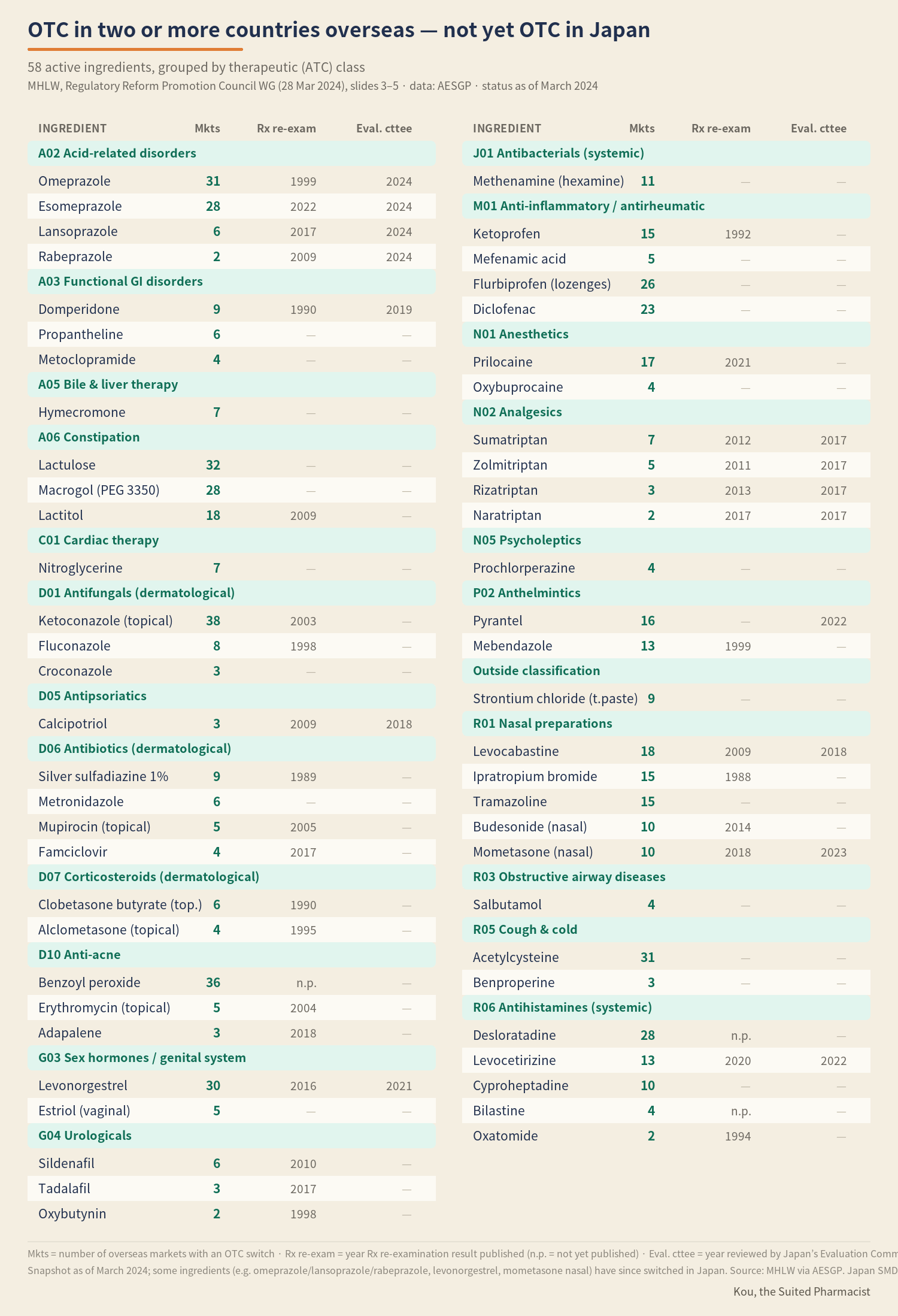
比較は、この代表例だけに限りません。日本政府自身が歴史的な一覧を作成しています。2024年3月、厚生労働省は規制改革のワーキンググループに、AESGPのデータに基づき、当時海外2か国以上でOTC化され日本ではOTC未承認だった58成分の一覧を提示しました。以下はその2024年3月時点の記録です。
The comparison extends beyond these examples. The Japanese government itself produced a historical catalogue: in March 2024, MHLW presented the regulatory-reform working group with 58 ingredients that, according to AESGP data, had been switched in at least two countries abroad but were not yet OTC-approved in Japan at that time. The image below preserves that March 2024 record.
「取り残された成分」:同じ薬効群の一部だけがスイッチOTC化されるとき
The "survivors": when half a drug class switches and half doesn't
最も多くを物語るのは、日本がまったく手をつけていない薬ではありません。ある薬効群の一部をスイッチOTC化しながら、近縁の成分を残している事例です。
The most revealing cases aren't the drugs Japan hasn't touched at all. They're the ones where Japan switched part of a class and left a close cousin behind.
例として、プロトンポンプ阻害薬を見てみましょう。日本ではラベプラゾールが2025年3月21日、オメプラゾールが同年6月27日、ランソプラゾールが同年7月10日に、要指導医薬品として承認されました。オメプラゾールは2025年8月に店頭に並びました。これは実際に起きた、最近の規制緩和です。しかし、エソメプラゾール(オメプラゾールの後継となる単一異性体で、米国とオーストラリアでは長くOTCとして販売されている成分)とパントプラゾールは、この一連の承認に含まれていませんでした。つまり、日本の胸やけ治療薬売り場には、置かれているPPIと置かれていないPPIがあります。この区別は、患者が実感する薬理作用とは無関係です。
Take proton pump inhibitors. Japan approved rabeprazole on March 21, 2025, omeprazole on June 27, 2025, and lansoprazole on July 10, 2025, as guidance-required OTC medicines. Omeprazole reached shelves in August 2025. That's a real, recent liberalization. But esomeprazole (the single-isomer successor to omeprazole, and a long-standing US and Australian OTC) and pantoprazole were not in that batch. So the heartburn aisle in Japan now holds some PPIs and not others — a distinction that has nothing to do with the pharmacology a patient experiences.
この3PPIについて、2024年12月20日の部会では承認可・要指導指定の議決が行われたが、正式な製造販売承認日は上記の2025年の日付である。部会判断、正式承認、発売を同じイベントとして数えない。 部会議事録
For these three PPIs, the December 20, 2024 subcommittee voted in favour of approval and guidance-required designation; the formal marketing-approval dates were the 2025 dates above. A committee decision, formal approval and market launch are separate events. Subcommittee minutes
花粉症向けのステロイド点鼻薬にも、同じ構図があります。日本ではフルチカゾンプロピオン酸エステル(フルナーゼ、2019年11月発売)とモメタゾンフランカルボン酸エステル(ナゾネックス、2025年9月発売)がOTC化されました。しかし、フルチカゾンフランカルボン酸エステル(同じステロイドの別のエステルで、米国では2017年からFlonase Sensimistという名称でOTC販売されている成分)は、今なお医療用に限られています。
The same pattern shows up in nasal steroids for hay fever. Japan switched fluticasone propionate (Flunase, launched November 2019) and mometasone furoate (Nasonex, launched September 2025) to OTC — but fluticasone furoate (a different ester of the same steroid, sold OTC in the US as Flonase Sensimist since 2017) is still medical-use only.
こうした「取り残された成分」は、問題全体を考えるうえで有用な手掛かりです。類薬がすでにOTCとなっていることは、開発や適正使用を検討する材料になります。ただし、近縁成分の承認が、その成分・製品の品質、有効性、安全性やOTCでの適正使用の評価を代替するわけではありません。申請・審査の進み方と、個別製品に残る課題の両方を見る必要があります。 PMDA承認申請
These “survivors” are useful clues to the wider question. A related medicine’s OTC experience can inform development and appropriate-use planning. But approval of a close relative does not replace assessment of the individual ingredient and product’s quality, efficacy, safety and appropriate OTC use. Both progress through application and review, and the issues remaining for each product, need attention. PMDA approval applications
なぜ差が生まれるのか。その理由に当たらないもの
Why the gap exists — and what it is not
すべてを「日本は単に慎重だから」で説明したくなりますが、それでは考察が浅く、仕組みを見誤ります。より正確な構図は次のとおりです。
It's tempting to explain all this with "Japan is just more cautious," but that's lazy, and it gets the mechanism wrong. Here's the more accurate picture.
日本にスイッチOTC化のための区分が欠けているわけではありません。英国、オーストラリア、ドイツ、スイスなど、日本より速くスイッチOTC化を進める市場はいずれも、処方箋薬と自由な小売販売との間にある薬剤師が介在する中間区分を利用しています。英国の「Pharmacy(P)」、オーストラリアの「Pharmacist Only(S3)」、ドイツのapothekenpflichtig(薬局販売限定)がそれに当たります。日本にもまさにこれに相当する「要指導医薬品」という区分があります。新たにスイッチOTC化された薬には薬剤師の関与が必要です。2026年5月以降、対象製品は薬剤師がその都度適切と判断する場合に映像・音声による指導と遠隔販売を利用できます。ただし、特定要指導医薬品の販売・受渡しは引き続き対面が必要です。制度の構造上、日本には他国と同じような仕組みが備わっています。
Japan is not missing a switch category. Every market that switches drugs faster than Japan — the UK, Australia, Germany, Switzerland — does it through a pharmacist-mediated middle tier between prescription and free retail sale: the UK's "Pharmacy (P)" medicines, Australia's "Pharmacist Only (S3)," Germany's apothekenpflichtig. Japan has exactly this: the yō-shidō, "guidance-required" category, where a newly switched drug requires pharmacist involvement. Since May 2026, eligible products may use video-and-audio guidance and remote sales when the pharmacist judges it appropriate on each occasion; specified guidance-required medicines still need face-to-face sale and handover. Structurally, Japan is equipped like its peers.
したがって、差は別のところにあります。
So the gap lives elsewhere:
審査の速さ。日本OTC医薬品協会が2023年12月11日に示した資料の15頁には、2018年度以降に承認されたスイッチOTC等6品目の申請から承認までの期間が示されています。49、24、102、37、25、16か月で、範囲は16~102か月、6品目の算術平均は約42.2か月です。資料は追加解析・試験を求められた例も挙げています。これは当該6品目の申請後の期間であり、要望から承認までの全期間や、すべての候補の平均ではありません。 協会一次資料15頁
特定の薬効群に対するリスクの捉え方。避妊薬や勃起不全治療薬では、誤用や濫用への懸念を含め慎重な検討が行われてきました。ただし、「慎重」は「停止」と同じではありません。別のPDE5阻害薬であるタダラフィルは、2025年9月18日の部会審議を経て、2026年5月20日にシアリスの要指導医薬品としての正式承認を取得しました。本記事の2026年7月4日時点では承認済み・未発売であり、部会判断、製品承認、店頭発売は別の段階です。この進展は、シルデナフィルを薬効群全体の門前払いではなく、群内の差として考える手掛かりになります。規制当局が何を懸念し、どう管理するかは、市場・製品ごとに確かめる必要があります。 部会2025 / 正式承認2026年5月 / 厚労省一覧
実際に存在する逆方向の動き。政策の一方の手がセルフメディケーションの拡大を進める一方、もう一方では規制の強化が進んでいます。日本では2026年5月から、過量服薬の問題に対応するため、乱用のおそれがあるOTC薬(「指定濫用防止医薬品」)のルールが強化され、購入理由の確認や包装単位の制限が加わりました。拡大と制限が同時に進んでいることも、全体の歩みが慎重に見える一因です。
Pace of review. Page 15 of the Japan OTC Medicines Association’s December 11, 2023 presentation reports application-to-approval times for six switch-OTC and related products approved from FY2018 onward: 49, 24, 102, 37, 25 and 16 months. The range is 16–102 months, and their arithmetic mean is about 42.2 months. The presentation also describes requests for additional analysis or trials. These are post-application periods for those six products, not the full request-to-approval timeline or an average for every candidate. Association presentation, page 15
Risk posture on specific classes. Contraceptives and erectile-dysfunction medicines have received careful consideration, including concerns about misuse and abuse. But “conservative” is not “frozen.” After the September 18, 2025 subcommittee discussion, tadalafil received formal approval as the guidance-required OTC product Cialis on May 20, 2026. At this article’s July 4, 2026 reference date, it was approved but not yet launched: a committee decision, product approval and retail launch are separate stages. This progress helps frame sildenafil as a difference within the class rather than exclusion of the whole class. Regulators’ concerns and risk-management conditions still need checking by market and product. 2025 subcommittee / May 2026 approval / MHLW list
A genuine counter-current. While one arm of policy pushes to expand self-medication, another is tightening it. From May 2026, Japan strengthened rules on abuse-prone OTCs (the "指定濫用防止医薬品" category), adding purchase-reason checks and pack-size limits in response to overdose problems. Expansion and restriction are happening at once, which is part of why the overall pace feels hesitant.
実際に動いているもの
What's actually moving
状況は固定されていません。日本のOTC市場への参入を計画する人にとって、変化の方向は重要です。
The picture isn't static, and the direction of travel matters for anyone planning a Japan OTC entry.
最近の変化で最も明確なのは、緊急避妊薬です。薬局で数年にわたる試験的な取り組みを経て、レボノルゲストレルの緊急避妊薬(ノルレボ)は2025年10月に承認され、2026年2月には研修を受けた薬剤師のいる薬局で販売が始まりました。年齢制限はなく、保護者の同意も不要ですが、その場で薬剤師の面前で服用しなければなりません。これは、日本初の「特定要指導医薬品」となりました。この新たな下位区分は、まさに製品のスイッチOTC化と薬剤師による厳格な管理の両立を目的に設けられたものです。これはあくまで緊急避妊薬であることに注意してください。日常的に継続して服用する経口避妊薬には、依然として処方箋が必要です。そのため、前述のデソゲストレルは、緊急避妊薬がOTC化された際にもスイッチされませんでした。この2つを混同することが、この分野で最も陥りやすい誤りです。
The clearest recent shift is emergency contraception. After a multi-year pharmacy pilot, levonorgestrel emergency contraception (Norlevo) was approved in October 2025 and reached trained-pharmacist pharmacies in February 2026 — with no age limit and no parental consent required, though it must be taken on the spot in front of the pharmacist. It became Japan's first "specified guidance-required" drug (特定要指導医薬品), a new sub-category built precisely to switch a product and keep it under tight pharmacist control. Note that this is the emergency pill; the ongoing daily contraceptive pill remains prescription-only — which is why desogestrel, above, didn't switch when emergency contraception did. Conflating the two is the single easiest mistake to make in this space.
その背景では、政府の規制改革推進会議が、期間の短縮と、「すでに2か国以上でスイッチされた成分は、原則として日本でもスイッチする」という基本原則を推し進めています。本記事もこの考え方に沿っており、上記の58成分のリストもそれに基づいています。この原則が審議の滞留という現実に直面しても機能するのかが、今後数年間の注目点です。
Behind that, the government's Regulatory Reform Promotion Council has pushed for faster timelines and a working principle: ingredients already switched in two or more countries should, in principle, be switched in Japan too. That's the framing this article borrows, and the rationale behind the 58-ingredient list above. Whether the principle survives contact with the deliberation backlog is the story to watch over the next few years.
3つの立場から見る
The three-sided view
薬局の現場から見ると、取り残された成分の問題は日常の不思議です。ある胸やけの薬は棚にあるのに、ほぼ同じ別の薬にはなぜ受診が必要なのかを、お客様に説明しなければなりません。
From the frontline pharmacy, the survivor problem is a daily oddity: explaining to a customer why one heartburn drug is on the shelf and its near-twin needs a clinic visit.
薬事・規制の側から見ると、遅い歩みは怠慢ではありません。専門家ではない一般消費者の声を意図的に含めた、公開の合意形成型委員会で審議することの代償です。加えて、1件ずつ申請を扱う仕組みのため、一度に薬効群全体を承認することはできません。
From the regulatory side, the slow pace isn't negligence. It's the cost of a public, consensus-driven committee that deliberately includes lay consumer voices, paired with a one-application-at-a-time pipeline that simply can't clear a class in a single move.
製薬業界の側から得られる教訓は、「海外で承認済み」は議論の出発点であり、結論ではないということです。すでにスイッチされた薬の近縁成分は、参入機会を探す手掛かりになり得ます。ただし、類薬の実績だけで安全性の論拠が完成するわけではありません。個成分・製品の品質、有効性、安全性と、販売時の適正使用の評価が必要です。処理速度と、個別製品の審査上・事業上の条件をともに見極めることが重要です。 PMDA承認申請
From the industry side, “approved abroad” is a starting argument, not a conclusion. Close relatives of already-switched medicines may be useful leads when looking for entry opportunities. A related medicine’s experience does not complete the safety case: the individual ingredient and product still need assessment of quality, efficacy, safety and appropriate use at sale. Review throughput and each product’s regulatory and commercial conditions both matter. PMDA approval applications
免責事項
Disclaimer
本記事の規制分析は著者個人の理解に基づくものであり、公式な法的助言や規制上の助言を提供するものではありません。規制は頻繁に変わるため、事業上の意思決定を行う前に一次資料で確認してください。
The regulatory analysis in this article reflects the author's personal understanding and does not constitute official legal or regulatory advice. Regulations change frequently — verify with primary sources before making business decisions.
記事の掲載先
noteで読むほか、Substackでは日本語・英語の各媒体を購読できます。
共有するのは、どなたでも開ける公開原文のリンクです。