これまでの4回では、製品を追ってきた。日本がどのようにOTCへのスイッチを行い、分類し、手続きを進め、候補を並べているのかを見てきた。今回は、その仕組みをカウンターで機能させなければならない人に焦点を当てる。
The last four issues followed the product: how Japan switches, classifies, processes, and queues its OTC drugs. This issue follows the person who has to make that system work at the counter.
医薬品がOTCの棚に移ると、患者はより容易に入手できるようになり、業界はより大きな市場を得る。しかし、スイッチのたびに、別の誰かにも新しい仕事が渡される。販売現場の薬剤師と登録販売者だ。より大きな役割を担う準備はできているのか。そして、本人たちはそれを望んでいるのか。
When a drug moves to the OTC shelf, patients win more access and industry wins more market. But each switch also hands a new job to someone else: the pharmacist and the registered seller at the point of sale. Are they ready for the bigger role — and do they want it?
グローバル製薬企業やコンシューマーヘルス企業の読者にとって、これは単なる人物紹介的な、軽い話題ではない。日本のセルフメディケーション推進策で、進展の速度を左右するのは現場の担い手だ。どれほどチャネルを開放しても、相談に応じ、判断し、ときには販売を断らなければならない人に余裕がなかったり、目指す方向がずれていたりすれば、政策は停滞する。
For a global pharma or consumer-health reader, this is not a soft "human interest" question. The frontline workforce is the rate-limiting step for Japan's self-medication agenda. You can open up channels all you like; if the person who has to counsel, judge, and sometimes refuse a sale is stretched thin or pointed the wrong way, the policy stalls.
背景と文脈:「対物から対人へ」という10年来の政策
Background & Context — "From product to patient," a decade-old policy
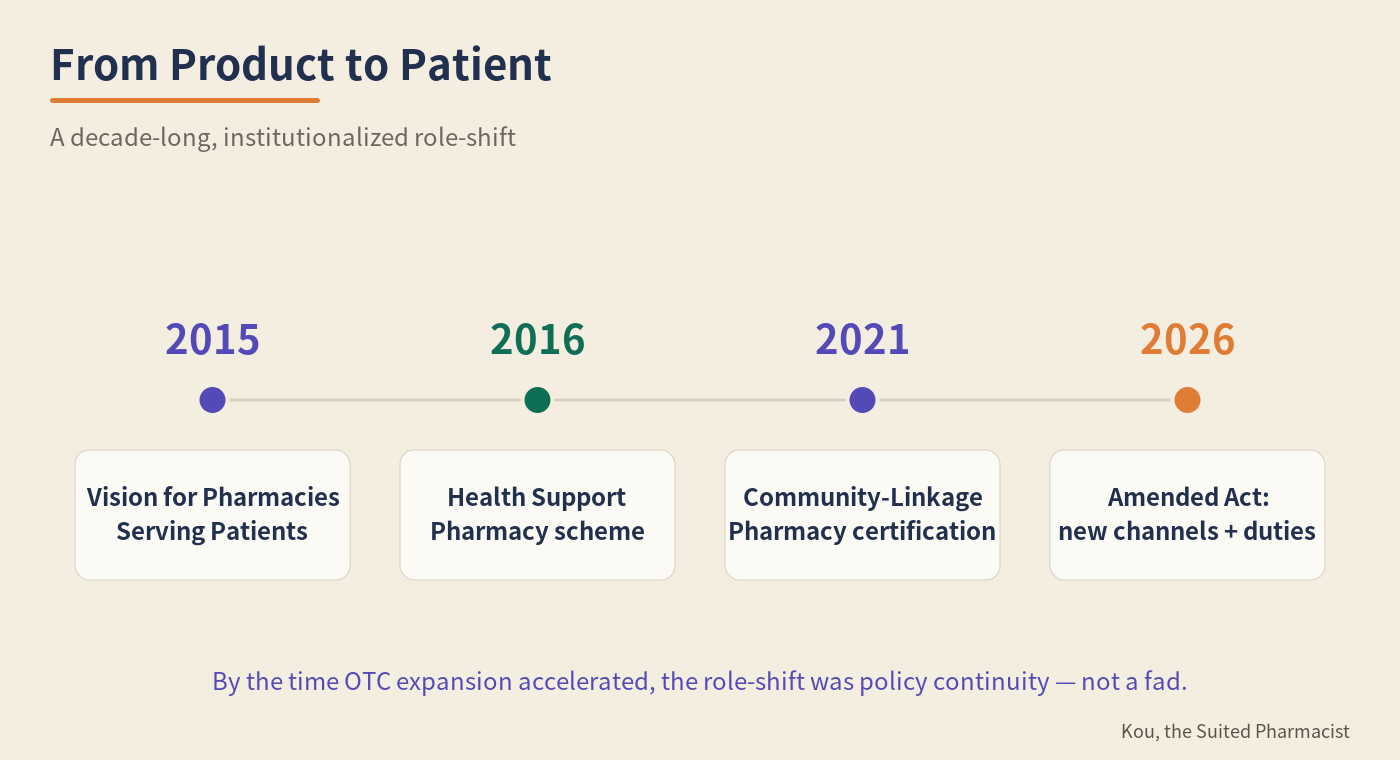
日本の薬剤師の役割は、2026年に初めて変わり始めたわけではない。その転換が正式に打ち出されたのは、厚生労働省が「患者のための薬局ビジョン」を公表した2015年10月だった。「対物業務から対人業務へ」と「立地から機能へ」という二つの標語が方向性を定めた。薬剤師は、薬を数えて交付する業務から、相談対応、継続的な薬学的管理、セルフメディケーション支援へと軸足を移すべきだ、というものだ。
Japan's pharmacist role did not start changing in 2026. The shift was formalized in October 2015, when the MHLW published the "Vision for Pharmacies Serving Patients." Its two slogans — "from product-centered to patient-centered" and "from location to function" — set the direction: pharmacists should move from counting and dispensing toward counseling, ongoing medication management, and self-medication support.
その後、ビジョンは制度に組み込まれた。健康サポート薬局の届出制度は2016年に始まり、地域連携薬局と専門医療機関連携薬局の認定は2021年8月に始まった。OTC拡大が加速する頃には、役割の転換は標語ではなく、10年にわたる政策の流れになっていた。だからこそ、新規参入企業は日本のセルフケア市場を、一過性の流行ではなく、政策主導で比較的予測しやすい市場として捉えるべきなのである。
Then the vision was built into institutions. The Health Support Pharmacy disclosure scheme began in 2016; the Community-Linkage Pharmacy and Specialized-Care Linkage Pharmacy certifications began in August 2021. By the time OTC expansion accelerated, the role-shift was not a slogan but a decade-long policy line. That is exactly why new entrants should treat Japan's self-care market as policy-driven and fairly predictable, not faddish
誰が何を売るのか:二層の担い手
Who sells what — the two-tier workforce
担い手が二つに分かれているので、簡単に整理しておこう。第1類医薬品を販売できるのは薬剤師のみで、情報提供は義務である。要指導医薬品には、薬剤師による指導が必要だ。2026年5月からは、薬剤師がその都度適切と判断する場合、映像と音声による指導も可能となった。ただし、特定要指導医薬品の販売・受渡しは引き続き対面で行う。第2類・第3類医薬品は、登録販売者が販売できる。登録販売者は、薬剤師以外でもリスクの低いOTCを扱えるようにするため、2009年の薬事法改正で設けられた、都道府県が認定する公的資格である。
A quick refresher, because the workforce is split in two. Class 1 OTC drugs can be sold only by a pharmacist, and information provision is mandatory; guidance-required drugs need counseling by a pharmacist. Since May 2026, this may use video and audio when the pharmacist judges it appropriate on each occasion; specified guidance-required drugs still require face-to-face sale and handover. Class 2 and Class 3 drugs can be sold by a registered seller — a public, prefecture-certified qualification created by the 2009 Pharmaceutical Affairs Law revision so that non-pharmacists could handle lower-risk OTC.
2009年の改革があったからこそ、ドラッグストアは全国に規模を拡大できた。それ以降、登録販売者試験にはおよそ40万人が合格している(控えめな累計値であり、引用前に厚生労働省の最新の試験統計で確認が必要)。その結果、薬剤師は手厚い対応が必要な区分に集中し、登録販売者は日常的なOTCの売り場を担うという分業が生まれた。
That 2009 reform is what let drugstores scale nationwide. Since then, on the order of 400,000 people have passed the registered-seller exam (a conservative cumulative figure; confirm against the latest MHLW exam statistics before quoting). The result is a division of labor: pharmacists focus on the higher-touch tiers, while registered sellers run the everyday OTC shelf.
2026年に加わるもの:チャネル拡大と業務増加が同時に進む
What 2026 adds — more channels, more duties, at once
2026年5月の改正法(令和7年法律第37号)は、アクセスを広げると同時に、責務を厳格化する。
The May 2026 amended Act (Act No. 37 of 2025) widens access and tightens duties in the same move.
アクセスの面では、薬剤師が遠隔で服薬指導を行う場合、要指導医薬品をオンライン販売できるようになった。ただし、対面での対応が必要とされる品目は、引き続き対面販売となる。
On access: guidance-required drugs can now be sold online when a pharmacist gives remote medication guidance — though items deemed to need in-person handling stay face-to-face.
責務の面では、同じ改正によって、薬剤師と登録販売者が濫用防止の関門となる。「指定濫用防止医薬品」の区分は2026年5月に8成分へ拡大し、年齢確認、まとめ買いの理由の確認、未成年者に対する少量包装への制限といったルールが加わった。したがって、OTCメーカーへの本当のメッセージは、「チャネルが開放されるから自由に売ろう」ではない。「チャネルが広がると同時に、販売時の法令遵守の負担も重くなる」ということだ。
On duties: the same reform makes pharmacists and registered sellers the abuse-prevention gatekeepers. The "designated abuse-prevention drugs" category grew to eight ingredients in May 2026, adding rules on age checks, reasons for bulk purchases, and small-volume limits for minors. So the real message for OTC makers is not "channels are opening up, sell freely." It is "channels are widening and point-of-sale compliance is getting heavier" — at the same time.
日本の逆説:数は多いが偏在し、削減も求められる
The Japanese paradox — abundant but maldistributed, and told to shrink
ここに、英国や米国とは異なる日本のねじれがある。日本は、単純に薬剤師が足りないわけではない。登録薬剤師数は2024年末時点で過去最多の329,045人に達し、政府の推計は今後数十年で供給過剰になることを示している。2026年4月、財務省はさらに踏み込み、将来の余剰を理由に薬学部定員の「大胆な」削減を求めた。
Here is the twist that sets Japan apart from the UK or US. Japan does not have a simple pharmacist shortage. The number of registered pharmacists hit a record 329,045 as of end-2024, and government projections point to oversupply in the coming decades. In April 2026, the Ministry of Finance went further, urging a "bold" cut to pharmacy-school quotas because of the future surplus.
それでも、多くの地域では人手不足が実感されている。薬剤師は都市部に集中しており、2022年のデータでは、北海道の薬剤師の約46%が札幌に集中している。薬局がまったくない自治体もある。つまり本当の問題は、「数が少なすぎる」ことではない。「偏在しており、人数よりも付加価値を増やすことが求められている」ことだ。これは、薬剤師の権限拡大を人材不足への対策として正当化する英米の筋書きとは逆である。日本では、責任の拡大は、空いた勤務枠を埋めるためではなく、相談対応の質、セルフケア支援、濫用防止といった価値の創出によって正当化されなければならない。
And yet many regions feel short-staffed. Pharmacists cluster in cities — in Hokkaido, around 46% are concentrated in Sapporo, per 2022 data — and some municipalities have no pharmacy at all. So the real problem is not "too few." It is "maldistributed, and asked to add value rather than headcount." That flips the Anglo-American storyline, where expanded pharmacist authority is justified as a fix for workforce shortages. In Japan, expanded responsibility has to be justified as value creation — counseling quality, self-care support, abuse prevention — not as filling empty shifts.
国際比較:日本が先行する点、遅れている点
Global Comparison — where Japan leads and lags
二つの比較対象を見ると、構図がより鮮明になる。
Two reference points sharpen the picture.
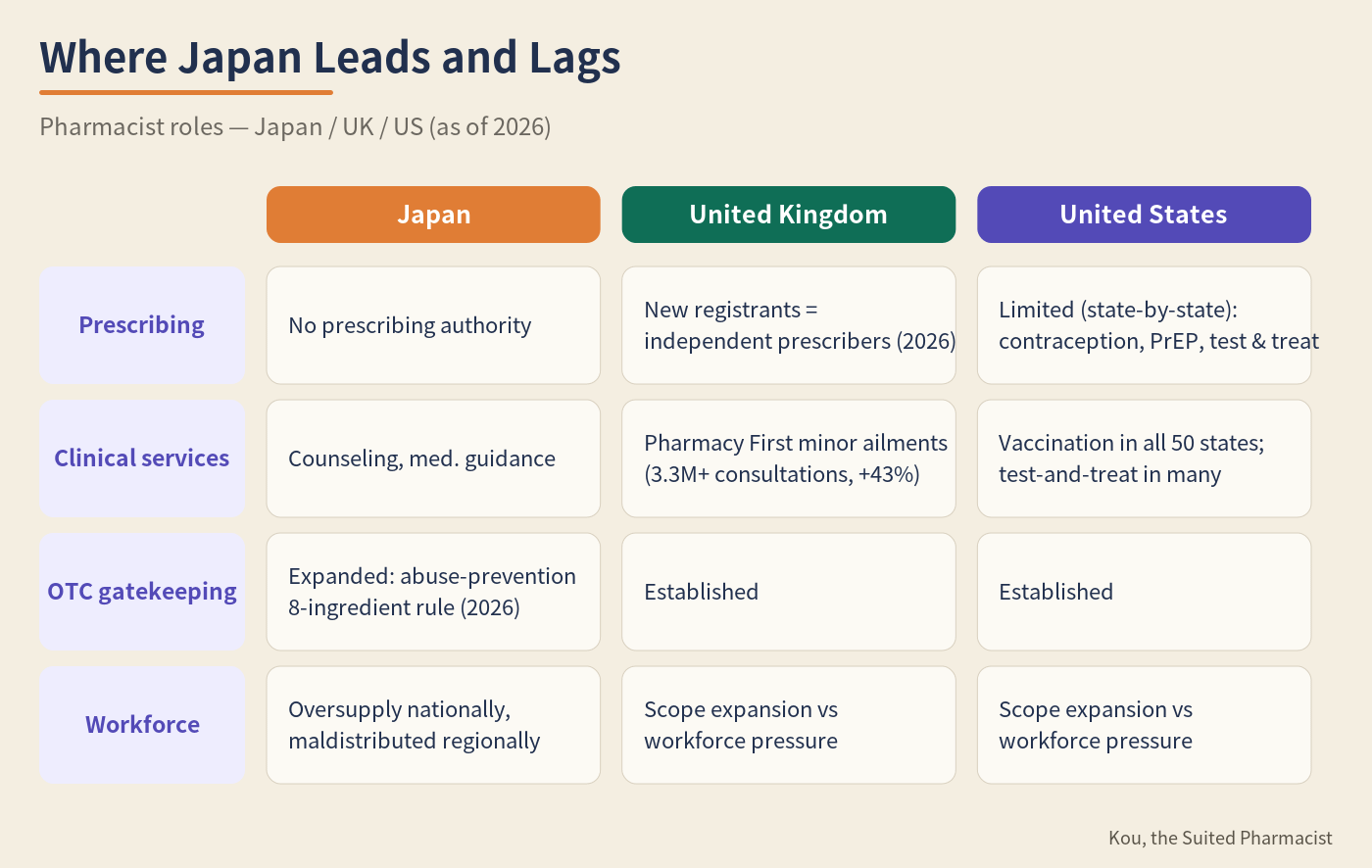
英国は、薬剤師を処方へと向かわせている。2026年夏から、2021年の初期教育・訓練基準で修了した新規登録薬剤師は、登録時から独立処方者の資格を持つ。また、約36億4,000万ポンドの財政支援策を背景に、「Pharmacy First」による軽症疾患の相談は、年間330万件を超えた(約43%増)。
The United Kingdom is pushing pharmacists toward prescribing. From summer 2026, newly registered pharmacists trained to the 2021 initial education and training standards qualify as independent prescribers from the point of registration, and "Pharmacy First" minor-ailment consultations passed 3.3 million in a year (up ~43%), backed by a funding package of about £3.64 billion.
米国では、臨床サービスが幅広く展開されている。2025年1月時点で、全50州が薬剤師によるACIP推奨ワクチンの接種を認めている。多くの州では検査から治療までの対応(インフルエンザ、溶連菌感染症、新型コロナ)を認め、一部では避妊薬やPrEP/PEPの処方も認めている。ただし、業務範囲は州ごとにまちまちだ。
The United States has gone broad on clinical services. As of January 2025, all 50 states let pharmacists administer ACIP-recommended vaccines, many allow test-and-treat (flu, strep, COVID), and some permit contraceptive or PrEP/PEP prescribing — though scope is a state-by-state patchwork.
日本は薬剤師の販売と相談・指導の役割を拡大してきたが、処方権の付与には至っていない。2026年の改正で拡大する範囲も、OTC販売管理、服薬指導、濫用防止にとどまる。グローバル製薬企業への示唆は具体的だ。日本の処方薬からOTCへのスイッチや、薬局主導のセルフケアの機会は、英米の「薬剤師の業務範囲を広げる」という定石とは異なる運営モデルで成り立っている。それに合わせて設計する必要がある。
Japan has expanded pharmacists' sales and counseling role but stopped short of prescribing authority. Even the 2026 reform keeps the gains in OTC sales management, medication guidance, and abuse prevention. For global pharma, the takeaway is concrete: Japan's Rx-to-OTC switch and pharmacy-led self-care opportunities run on a different operating model than the Anglo-American "expand pharmacist scope" playbook — design for it accordingly
日本はOTCへの扉を広げ続ける一方で、薬剤師に対して、将来的にはより少ない養成人数で、より多くの役割を果たすよう求めている。製品の話、つまりスイッチ、分類、候補リストは、制度の半分にすぎない。残る半分は、カウンターに立つ人が、相談対応、セルフケア支援、濫用防止を同時に担えるかどうかだ。日本のセルフメディケーション推進策が実際にどこまで進むかを決めるのは、個々のスイッチ判断以上に、この点である。
Japan keeps opening the OTC door wider while telling its pharmacist workforce to do more with — eventually — fewer trainees. The product story (switch, classify, queue) is only half the system. The other half is whether the person at the counter can carry counseling, self-care support, and abuse prevention all at once. That, more than any single switch decision, will decide how far Japan's self-medication agenda actually travels.
本記事の規制に関する分析は、著者個人の理解を反映したものであり、正式な法律上または規制上の助言を構成するものではありません。規制は頻繁に変更されます。事業上の意思決定を行う前に、一次資料で確認してください。
The regulatory analysis in this article reflects the author's personal understanding and does not constitute official legal or regulatory advice. Regulations change frequently — verify with primary sources before making business decisions.
記事の掲載先
noteで読むほか、Substackでは日本語・英語の各媒体を購読できます。
共有するのは、どなたでも開ける公開原文のリンクです。